Singing Is More Physical Than Most People Realize
Singing is an incredibly physical activity.
When you really stop and think about what’s happening in your body when you sing—breath, airflow, vocal folds, resonance, tone shaping—you begin to realize that you’re using far more of your body than you might assume.
That’s why many professionals refer to singers as vocal athletes.
And if you follow that idea just one step further, something important becomes obvious.
In athletics, nobody trains alone.
Every serious athlete—at every level—has a coach.
You don’t just fall out of bed performing at a high level. There’s always training behind it.
The Truth About Natural Talent
There are two very common beliefs about singing.
Everyone can sing.
Great singers are just born that way.
The truth lives somewhere in between.
Yes—you were born with the physical equipment to sing. Breath, vocal folds, resonance chambers—it’s all there.
But that doesn’t mean you automatically know how to use it.
And on the other side, the idea that great singers are simply gifted from birth is misleading. Many professional singers work extensively with vocal coaches—often behind the scenes—to refine their technique, expand their range, and improve their control.
Great singers aren’t just discovered—they’re developed.
Singing for Joy vs Singing for Growth
Let’s make an important distinction.
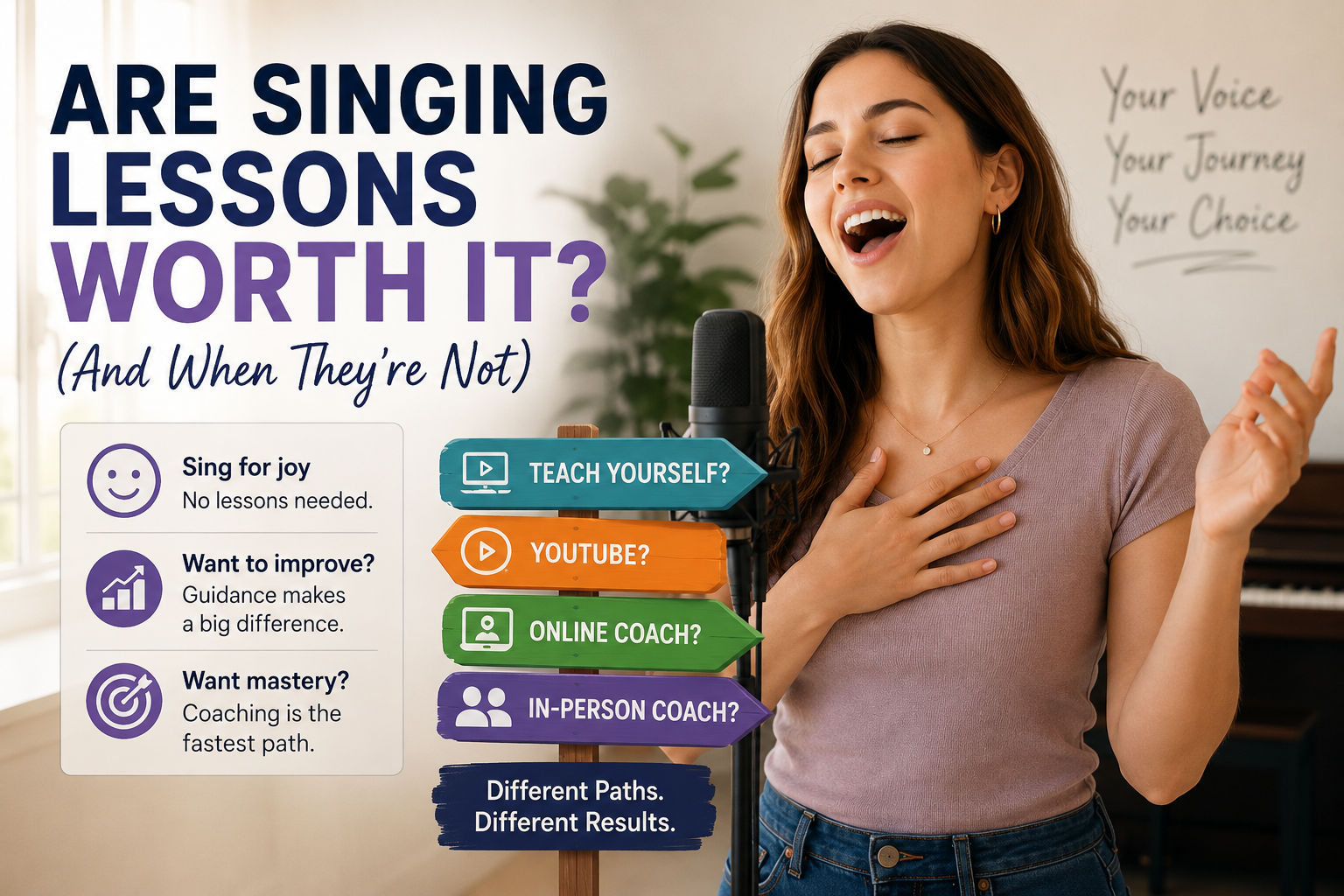
If you love singing in the car, in the shower, or with friends, you don’t need lessons.
Singing is joyful. It’s expressive. It even has real physical and emotional benefits—releasing positive chemicals in the body and creating a sense of connection and lift.
We absolutely encourage that.
But if you’re someone who feels stuck, struggles to hit certain notes, or wants to sound better, stronger, or more in control, then you’re in a different category.
Most people don’t stop singing—they just stop improving.
And that’s usually where the question of lessons starts to matter.
Why So Many Singers Get Stuck
One of the biggest challenges with singing is that you can’t clearly see—or always feel—what’s going wrong.
You might try to match your favorite artist and fall short.
You might feel tension but not understand why.
You might run out of range, lose power, or struggle with pitch.
Without feedback, it’s easy to repeat the same patterns over and over without realizing it.
Over time, that leads to plateaus.
The Limits of Learning From YouTube
There’s a lot of vocal advice online.
And to be fair, some of it can be helpful.
But there’s a major limitation.
It’s not structured.
It’s not sequential.
And it’s not personalized.
You end up jumping from one tip to another, trying different exercises without understanding how they fit together.
In some cases, it can even reinforce habits that hold you back.
For example, many modern singers use a breathy tone stylistically. But if you train your voice that way all the time, you may never develop proper vocal fold closure—limiting your power, range, and long-term growth.
Random tips don’t create lasting progress. A clear path does.
Your Voice Is Unique And That Matters
Not every voice is built the same.
Just like instruments in an orchestra, voices operate in different ranges and tonal characteristics.
Some voices are naturally higher. Some are lower. Some are built for power. Others for warmth or agility.
So when you try to copy another singer exactly, it can create frustration.
Sometimes the issue isn’t that you can’t sing it.
It’s that the song isn’t in the right key for your voice, or you’re approaching it in a way that doesn’t fit your natural design.
Learning how your voice works is a huge part of unlocking progress.
What a Great Vocal Coach Actually Does
A skilled vocal coach doesn’t just give you random exercises.
They guide you through a sequence of development.
They help you build proper breath support.
They help coordinate your vocal folds.
They help expand your range safely.
They improve your tone, resonance, and pitch accuracy.
They help you express emotion and meaning in a song.
They help you understand what’s happening in your body—and how to adjust it.
A great coach shortens the distance between where you are and what you’re trying to become.
Are Singing Lessons Worth It
It depends on what you want.
If your goal is casual enjoyment, personal expression, or just having fun singing along to your favorite songs, you don’t need lessons.
But if your goal is improvement, confidence, control, power, and range—becoming the best singer you can be—then guidance becomes incredibly valuable.
And in most cases, it’s the fastest and most reliable path forward.
Different Paths to Learning Singing
At this point, most singers explore one of a few paths.
Some try to teach themselves.
Some rely on YouTube videos.
Some take occasional lessons.
Some work consistently with a vocal coach, either online or in person.
Each of these approaches can lead somewhere.
But they don’t lead to the same results.
Understanding the differences between these paths—and which one fits you—is what ultimately determines how far and how fast you’ll grow.
Final Thought
If you’re asking whether singing lessons are worth it, there’s a good chance you already feel the gap between where you are and where you want to be.
The question isn’t just whether lessons are worth it.
It’s whether you want to keep guessing your way forward or follow a clearer path toward the voice you know is in you.
You don’t need lessons to sing. But if you want to truly develop your voice, the right guidance can change everything.