Why This Question Matters More Than You Think
At first glance, this might feel like a simple question.
Can you teach yourself to sing, or do you need a vocal coach?
But underneath that question is something deeper.
How do you actually learn a complex, physical, expressive skill?
Because singing isn’t just knowledge.
It’s something you have to do, feel, and experience in your body.
You don’t learn singing by understanding it. You learn singing by doing it correctly over time.
The Limits of Teaching Yourself
Let’s consider something for a moment.
If you wanted to become a heart surgeon, would you try to teach yourself?
Of course not.
Not because you’re not capable of learning, but because the process requires guidance, structure, and real time feedback.
Now, singing isn’t surgery.
But it shares something important in common.
It’s experiential.
You can’t learn how to coordinate breath, vocal folds, resonance, and tone just by reading about it or casually experimenting.
And there’s an old idea that applies here.
You don’t know what you don’t know.
Without guidance, it’s very easy to miss the things that matter most.
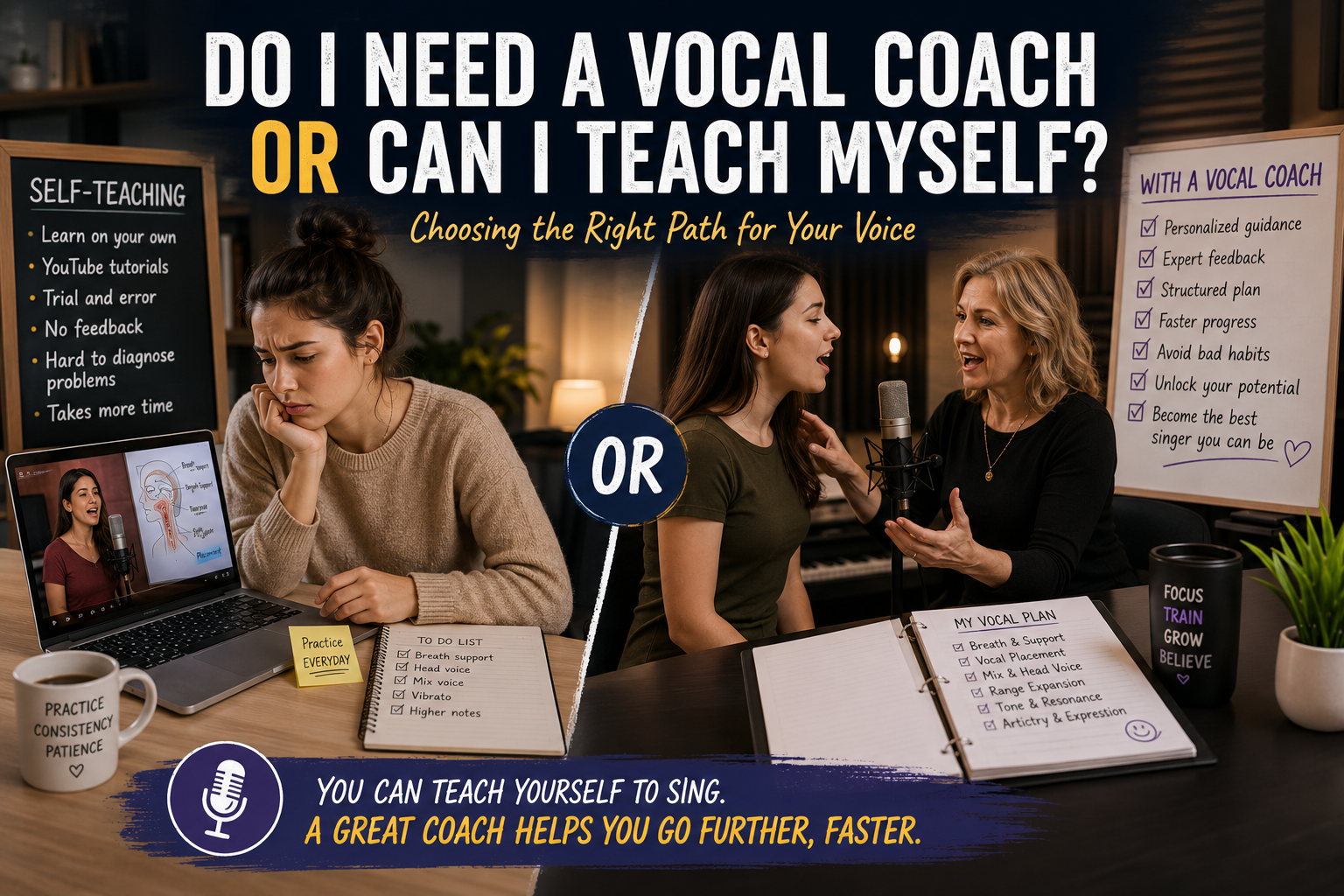
Yes You Can Teach Yourself to a Point
Let’s be fair.
You absolutely can teach yourself singing, at least to a certain level.
You can listen to great singers, imitate what you hear, practice consistently, and develop some natural instincts.
Some people even reach a level where:
They are told they have a nice voice
They perform casually
They sing in a band or local setting
But eventually, most self taught singers run into limitations.
Where Self Teaching Starts to Break Down
At some point, questions begin to surface.
Why can’t I reach certain notes
Why does my voice feel strained
Why is my tone inconsistent
Why can’t I stay on pitch reliably
And more importantly:
What exactly should I fix first
This is where self teaching becomes difficult.
Because even if you are working hard, you are still guessing.
Effort without clarity leads to plateaus.
Why Singing Is Hard to Self Diagnose
One of the biggest challenges with singing is that the mechanics are largely invisible.
You can’t directly see what your vocal folds are doing, how your breath is supporting the tone, or where your resonance is actually landing.
Even when you listen back to yourself, you may not hear what needs to change.
Students are often surprised when they see visual pitch tools or hear recordings that don’t match what they thought they were doing.
Without trained feedback, it’s easy to reinforce habits that feel right but are actually limiting your growth.
What a Vocal Coach Actually Brings
A great vocal coach does much more than give you exercises.
They bring a complete system.
They guide you step by step through breath support, vocal fold coordination, resonance and placement, range development, pitch accuracy, tone shaping, and emotional expression.
They help you understand not just what to do, but how to do it, when to do it, and why it works.
A coach doesn’t just give you answers. They help you ask better questions.
Beyond Technique Becoming an Artist
This is where coaching becomes even more valuable.
Because singing is not just about hitting the right notes.
It is about shaping phrases, expressing emotion, understanding lyrics, and communicating meaning.
It is about making choices.
Knowing when to use vibrato and when not to
Knowing how to shade a pitch to fit your voice
Knowing how to adjust a melody so it works for you
These are not things most singers figure out on their own.
Technique gives you control. Identity gives you impact.
The Difference Between Imitation and Identity
Many self taught singers become very good at imitation.
They can sound like different artists on different songs.
That can be impressive.
But it does not necessarily lead to a clear artistic identity.
Working with a coach helps you develop your sound, your strengths, and your interpretive voice.
So instead of copying others, you begin to understand what you bring to the music.
So Do You Need a Vocal Coach
It comes down to your goals.
If your goal is casual enjoyment, singing for fun, or learning at your own pace, you can absolutely teach yourself and enjoy the process.
But if your goal is consistent improvement, expanded range and control, strong technique, and confident expression, then working with a vocal coach becomes incredibly valuable.
And in most cases, it is the fastest and most reliable way forward.
Final Thought
You can teach yourself singing.
Many people do.
But the real question is not whether it is possible.
It is how far you want to go and how efficiently you want to get there.
At some point, every singer reaches a place where effort alone is not enough.
That is where guidance changes everything.
You don’t need a coach to begin. But the right coach can take you much further than guessing ever will.