
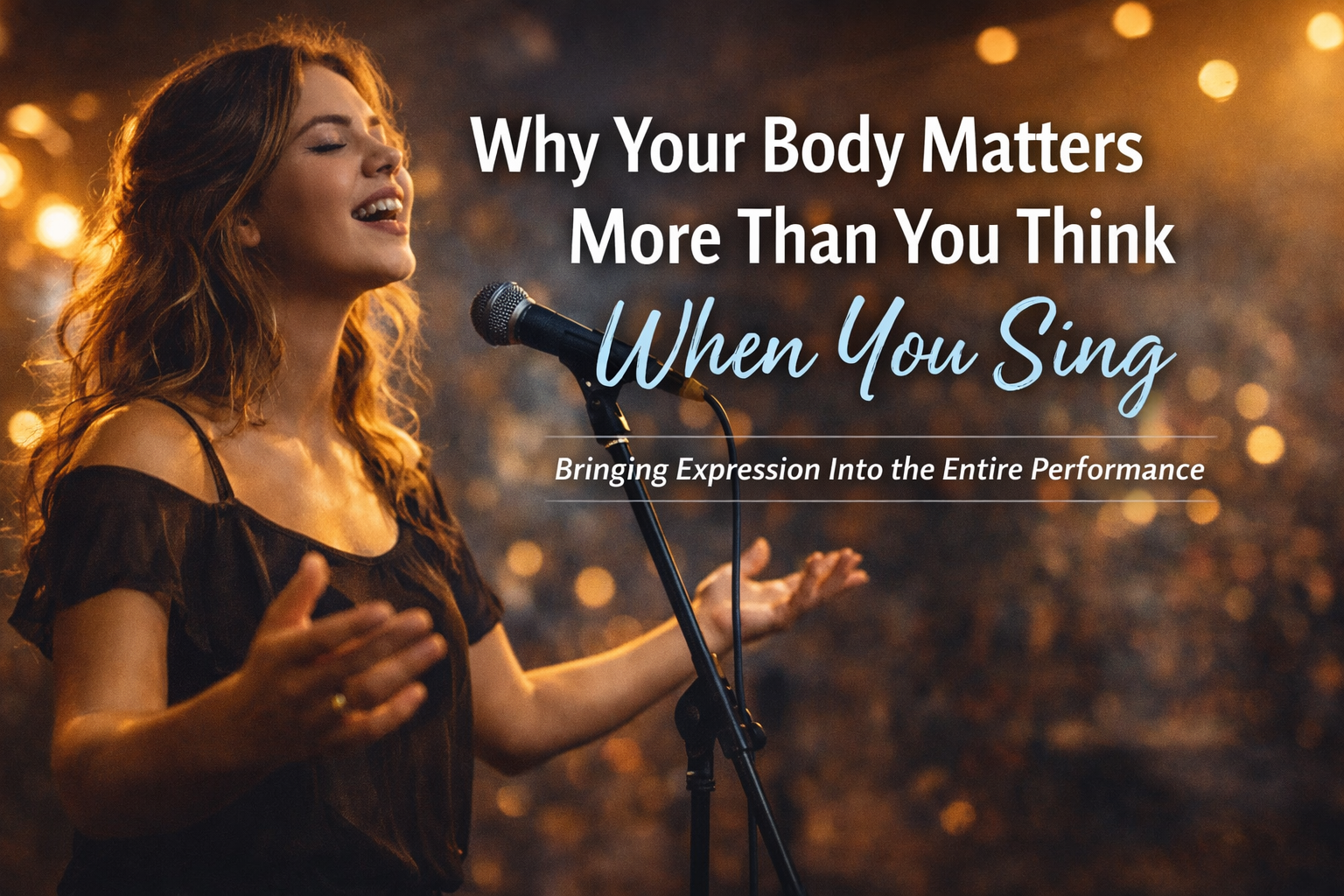
In the previous article, we explored emotional connection — how the voice begins to carry meaning. Now we look at how that meaning is expressed outwardly.
Singing doesn’t stop at the voice
Many singers think of singing as something that happens only from the neck up.
- breath
- vocal cords
- sound
But that’s only part of the picture.
Because once the sound leaves your body, something else takes over:
How it’s communicated.
And that involves your entire physical presence.
Your voice carries the sound. Your body carries the message.
Why stillness often leads to disconnection
Some singers are taught — directly or indirectly — to minimize movement:
- stand still
- don’t gesture too much
- focus on control
While that can help in early stages, it often creates a new problem:
The performance becomes visually and emotionally flat.
Even if the voice sounds good, the communication feels incomplete.
What “gesturing” really means
Gesturing doesn’t mean random movement or exaggerated performance.
It means that your body is aligned with what you’re expressing.
- your posture supports the phrase
- your face reflects the meaning
- your movement (or stillness) feels intentional
It’s not about doing more.
It’s about being integrated.
When the body and voice are aligned, the performance feels believable.
Why physical expression deepens connection
There’s a direct relationship between what you feel and how your body responds.
When a singer is truly connected:
- the body naturally wants to express
- gestures emerge without forcing
- stillness becomes intentional, not stiff
And interestingly, the reverse is also true:
When the body is engaged in a natural way, it can actually help deepen the emotional connection.
Why this is more than “stage presence”
It’s easy to think of this as performance polish.
But it goes deeper than that.
This is about:
- embodiment
- communication
- allowing the music to live through your whole system
Not just your voice.
Singing isn’t just something you do. It’s something you inhabit.
What happens when this piece is missing
When physical expression is disconnected, you may see:
- minimal or frozen movement
- facial expressions that don’t match the song
- a lack of visual engagement
Even if the singing is technically solid, something feels incomplete.
The audience may hear the sound…
…but not fully receive the message.
What it feels like when everything comes together
When breathing, timing, placement, and emotional connection are all working…
…and the body is allowed to participate:
- the performance feels natural
- communication feels direct
- the audience stays engaged
- the singer feels more free
There’s no sense of “putting on” a performance.
It feels like being inside it.
When the voice and body work together, the performance becomes real.
Why this completes the process
This is where all five pillars come together.
- Breath supports the voice
- Timing organizes it
- Placement frees it
- Emotional connection gives it meaning
- Gesturing allows it to be fully expressed
Without this final piece, something is always held back.
With it, singing becomes what it’s meant to be:
A complete form of communication.
When the whole body is involved, singing stops being something you perform — and becomes something you share.
When the voice, the breath, the timing, and the body are all working together, singing becomes something more than sound.
It becomes communication.
And it becomes something you can trust.
In the final article, we’ll bring everything together and show how these elements form a complete system for how to improve your singing voice step by step.