Why YouTube Feels Like It Should Work
YouTube is an amazing platform.
If you have a specific problem, you can search for it, find an answer, apply it, and often get a result. That’s a powerful thing, and for many areas of life, it works incredibly well.
So it makes sense that people would turn to YouTube for singing.
And to be fair, there is a lot of helpful content out there.
But singing development is cut from a different cloth.
Solving one problem is not the same as developing a skill.
Singing Requires a Step by Step Process
Learning to sing isn’t about fixing one issue at a time.
It’s about moving from where you are now to where you want to be through a sequential, layered process.
There are multiple elements working together at once.
Breath support
Vocal fold coordination
Pitch accuracy
Tone placement
Resonance
Range development
These aren’t isolated skills. They build on each other.
And the order matters.
Real progress comes from sequence, not randomness.
What YouTube Actually Gives You
Most YouTube videos are designed to do one thing.
Capture your attention.
A vocal coach might demonstrate a powerful high note, a unique tone, or an impressive technique.
And that’s inspiring.
But often, what you’re seeing is a step much further down the developmental path.
What’s usually missing is:
What came before that step
What should come after it
How it fits into a larger progression
So even if you manage to imitate something from a video, you’re often missing the foundation that makes it sustainable.
The Fairy Godmother Problem
There are moments where YouTube can genuinely help.
If you happen to know exactly what your issue is, search for it clearly, and find a video that addresses that exact issue, you might get a useful insight.
That does happen.
But it depends on something most singers don’t yet have.
Accurate self awareness.
And it also relies on something else that many people unconsciously hope for.
The idea that you’ll stumble onto the one video that suddenly unlocks everything.
The moment where everything just clicks and your voice transforms overnight.
That’s what I call the Fairy Godmother Syndrome.
It’s the belief that somewhere out there is a single tip, a single exercise, or a single breakthrough moment that will instantly turn you into the singer you want to be.
The reality is very different.
Progress in singing doesn’t come from one magical moment.
It comes from a series of small, correct steps, built in the right order over time.
You can’t fix what you can’t clearly hear or feel and you can’t shortcut the process with one lucky discovery.
Why Self Diagnosis Is So Difficult
One of the biggest challenges in singing is that you don’t always know what’s actually happening.
You might think you’re on pitch and be far off.
You might think you’re supporting your voice and be underpowered.
You might think you’re placing tone correctly and be creating tension instead.
Even with tools, singers are often surprised by what’s really going on.
Without an external ear guiding you, it’s easy to reinforce the very habits that are holding you back.
Why Random Tips Don’t Lead to Long Term Growth
Let’s say you collect ten different vocal exercises from ten different videos.
Now what?
Which one should you do first
How long should you work on it
What should you feel when it’s working
What do you do when it doesn’t work
YouTube doesn’t answer those questions in a connected way.
So instead of building a clear path, you end up with fragments.
Information is not the same as a method.
What YouTube Cannot Replace
There’s something YouTube fundamentally cannot provide.
A complete, personalized, step by step curriculum.
No serious vocal coach is going to give away an entire multi year training system in disconnected free videos.
And even if they tried, it wouldn’t solve the core issue.
You still wouldn’t know where you are in the process.
You wouldn’t know what to focus on next.
And you wouldn’t have feedback.
Where YouTube Can Still Be Useful
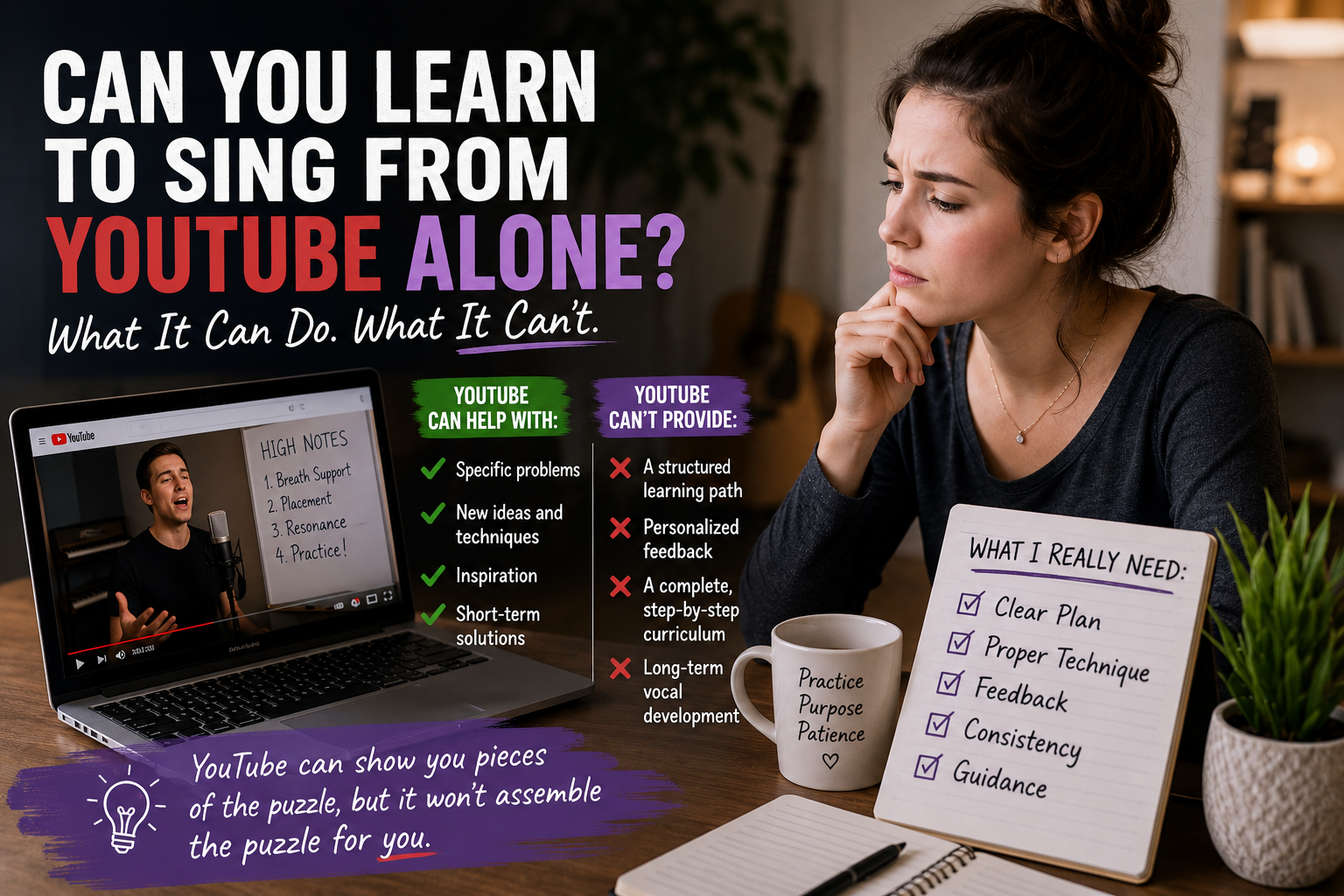
This doesn’t mean YouTube has no value.
It can be helpful for inspiration, exposure to ideas, occasional problem solving, and understanding concepts at a surface level.
Used this way, it can complement your growth.
But it doesn’t replace a structured path.
So Can You Learn to Sing From YouTube Alone
If the question is whether you can become a fully developed, technically sound singer using only YouTube, the honest answer is no.
Not because YouTube isn’t valuable.
But because it doesn’t provide sequence, personalization, feedback, or a complete developmental process.
However, if you use YouTube as a supplement and not a substitute, it can absolutely play a role in your journey.
The Real Difference
At some point, every developing singer runs into the same wall.
They stop improving.
Not because they lack effort.
But because they lack clarity.
That’s where guidance changes everything.
Progress accelerates when you stop guessing.
Final Thought
YouTube can show you pieces of the puzzle.
But it won’t assemble the puzzle for you.
If you’re serious about improving your voice and developing control, range, tone, and expression, you need more than isolated tips.
You need a path.
And you need someone who can help you walk it.
You don’t need to abandon YouTube but you shouldn’t expect it to take you all the way.