
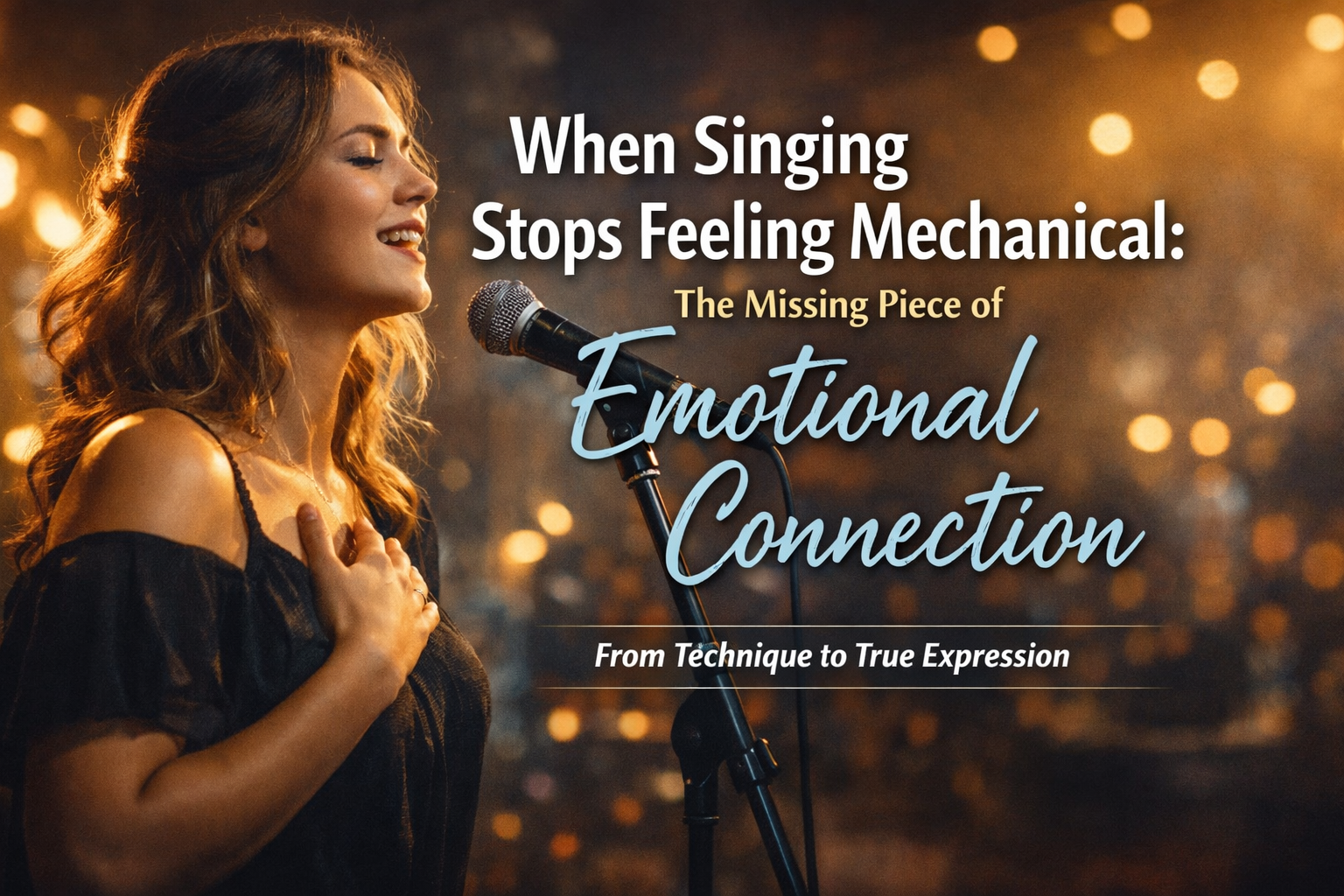
In the previous article, we explored how placement frees the voice. Now we move into what gives that voice meaning.
You can do everything “right” and still not move anyone
Some singers:
- hit the notes
- stay on pitch
- follow the phrasing
And yet… something feels missing.
The performance sounds correct, but it doesn’t feel alive.
If you’ve ever experienced that — either in yourself or when listening to others — you’ve already felt the difference between technique and connection.
Great singing isn’t just heard. It’s felt.
Why emotional connection can’t be added at the end
Many singers think of expression as something you “put on” after everything else is working.
But real connection doesn’t work that way.
You can’t simply decide to “add emotion” on top of:
- unstable breathing
- inconsistent timing
- or tense placement
Because when the voice is struggling, your focus goes to survival, not expression.
Emotional connection depends on technical freedom.
What it actually means to be connected to a song
Emotional connection isn’t about exaggeration or performance tricks.
It’s about:
- understanding what you’re singing
- relating it to something real inside you
- allowing that meaning to shape how the phrase comes out
When that happens, the voice changes — not because you forced it to, but because it’s responding to something genuine.
Why some singers sound disconnected
A disconnected sound often comes from one of two places:
- The focus is entirely on technique
The singer is thinking about breath, pitch, and control — but not meaning - The emotion isn’t fully internalized
The words are being sung, but not truly experienced
In both cases, the result is similar:
- the voice feels flat
- the phrasing feels neutral
- the listener doesn’t feel drawn in
What changes when connection is real
When a singer becomes genuinely connected to what they’re singing, something shifts:
- phrasing becomes more natural
- tone becomes more expressive
- subtle dynamics begin to appear
- the performance feels more personal and specific
And importantly…
The listener begins to feel something too.
When the singer feels it, the listener can feel it.
Why this requires readiness
Emotional connection can’t be rushed.
It depends on a certain level of:
- technical stability
- comfort in the voice
- ability to stay present while singing
Without that foundation, trying to “be expressive” often turns into:
- overacting
- tension
- or inconsistency
But when the voice is ready, connection doesn’t feel forced.
It feels natural.
The difference between sounding good and communicating
A technically solid performance might sound “good.”
But a connected performance communicates.
It invites the listener in.
It tells a story.
It creates a shared experience.
And that’s ultimately what singing is for.
Singing isn’t just about producing sound. It’s about communicating something real.
Why this is where singing becomes meaningful
For many singers, this is the moment everything changes.
Singing stops being:
- an exercise
- a performance task
- something to “get right”
And starts becoming:
- a form of expression
- a way to connect
- something deeply personal
When the voice is free and the connection is real, singing stops being mechanical — and starts becoming music.
When the connection is real, the voice begins to communicate.
But communication isn’t just internal — it also has to be expressed outwardly.
In the next article, we’ll look at how body language and physical expression in singing allow that emotion to be fully communicated outwardly.