
Most singers aren’t lacking effort. They’re lacking direction.
If you’ve spent any time trying to improve your voice, you’ve likely encountered a flood of advice:
- breathing techniques
- warm-ups
- placement tips
- performance ideas
And much of it can be helpful.
But there’s a hidden problem.
Most of it is disconnected.
So instead of building something steady, singers often end up:
- trying one thing, then another
- improving briefly, then regressing
- feeling like progress is inconsistent or unpredictable
The issue isn’t effort. It’s the absence of a clear path.
Why random improvement doesn’t lead to lasting results
Singing is not a collection of independent skills.
It’s a coordinated system.
And when you approach it randomly:
- you work on things out of order
- you reinforce compensations
- you create confusion in the body
For example:
- working on tone before breath leads to tension
- working on expression before stability leads to inconsistency
- working on performance before coordination leads to overwhelm
The result is effort without clarity.
Without sequence, even good advice can take you in the wrong direction.
What a sequence actually does
A sequence is not about rigid steps or rules.
It’s about understanding:
- what comes first
- what builds on what
- what your voice actually needs next
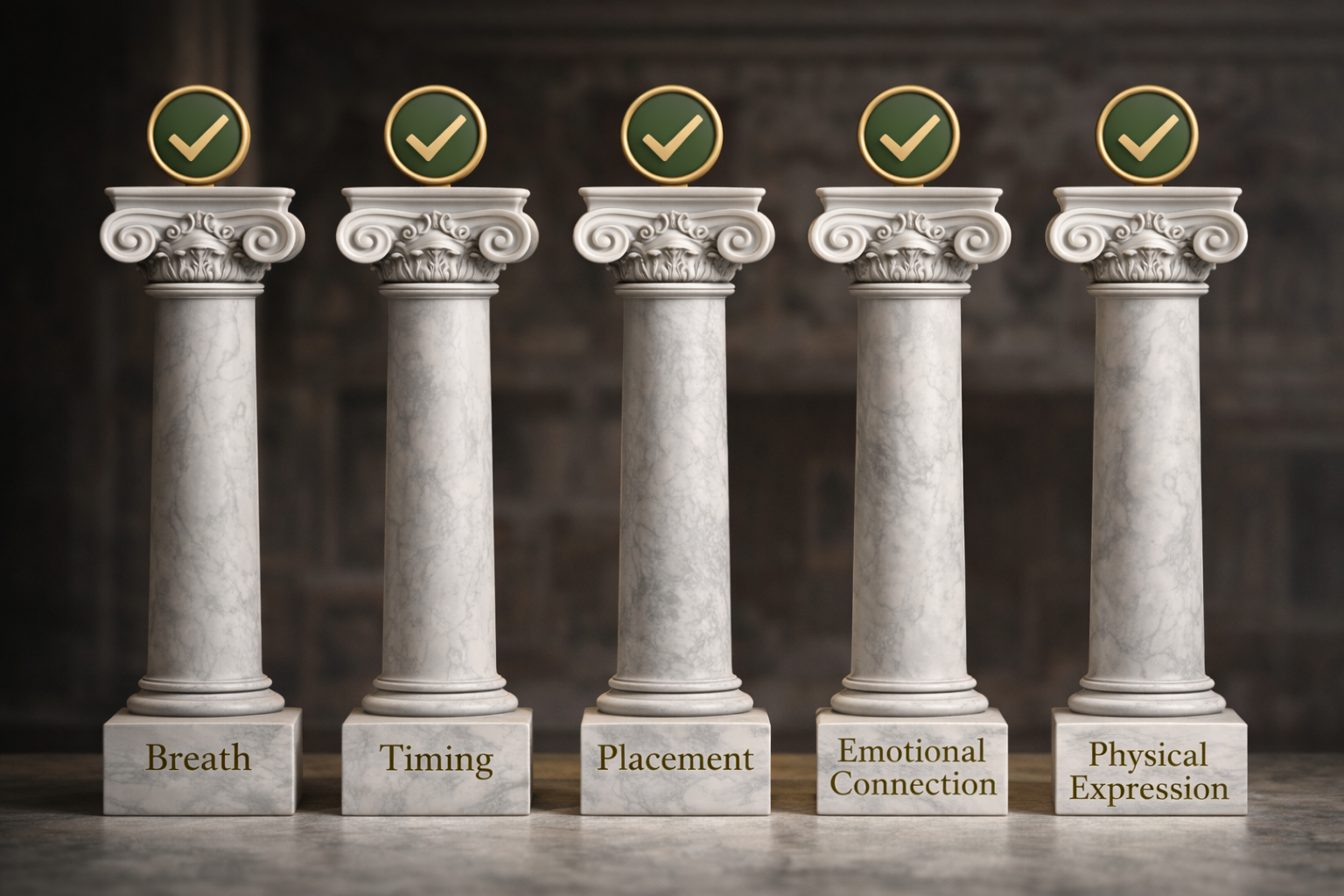
In this series, we explored five core areas:
• **Breath control in singing**
• **Timing and rhythm in singing**
• **Vocal placement and resonance**
• **Emotional connection in singing**
• **Body language and physical expression in singing**
Not as separate ideas…
…but as parts of a developmental process.
Each one supports the next.
Each one depends on the one before it.
Why a master teacher changes everything
One of the biggest differences between random learning and real progress is guidance.
Because a skilled teacher doesn’t just give you information.
They:
- listen to what’s actually happening in your voice
- identify what’s missing
- choose the next step that will create the most progress
And that step is not the same for every singer.
The right next step is what unlocks progress.
This is why:
- videos can help, but only to a point
- courses can inform, but not diagnose
- generic advice often falls short
Because your voice is not generic.
How real progress begins to feel different
When you start working within a sequence, something shifts.
Instead of:
- guessing what to work on
- jumping between ideas
- hoping something sticks
You begin to experience:
- clarity
- direction
- consistent improvement
The voice starts to feel more reliable.
The process starts to make sense.
Progress stops feeling random and starts feeling predictable.
Why this approach leads to freedom, not restriction
At first, the idea of a “sequence” might sound limiting.
But in practice, it does the opposite.
Because when the fundamentals are built in the right order:
- tension decreases
- coordination improves
- expression becomes easier
You’re not boxed in.
You’re supported.
What this means for your next step
If you’ve been trying to improve your voice by collecting tips, you’re not alone.
But there’s a more effective way forward.
Not by doing more…
…but by doing the right things in the right order.
Because when the process is clear, your voice has a chance to develop fully.
Great singing isn’t built from random breakthroughs. It’s built from a path you can follow.
If you’re just encountering this idea for the first time, the best place to begin is with the full framework:The 5 Pillars of Great Singing — where we walk step-by-step through the process that allows the voice to develop with clarity and consistency.